

| Create a Free Account or Sign In to connect and share in green living and alternative energy forum discussions. |
 0
0
Vertical-Axis Wind Turbines
Views: 930
Jun 15 2013 02:15 PM | eds in Wind Power
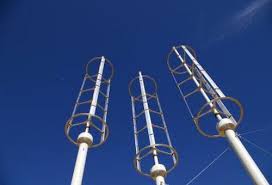 Caltech professor John Dabiri and his 10-meter-tall vertical-axis wind turbines,
. . . will set up another experimental wind farm, for a high school
. . . in San Pedro, military bases in California.
The Department of Defense is one of the largest energy consumers in the country,
. . . and is interested in using renewable methods to meet some of that need. However, one challenge with the use of wind energy is that large HAWTs
. . . can interfere with helicopter operations and radar signatures.
. . . Therefore, the Office of Naval Research is funding a 3 year project
. . . by Dabiri's group to test the smaller VAWTs and
. . . to further develop software tools to determine the optimal placement of turbines. "We believe that these smaller turbines
. . . provide the opportunity to generate renewable power
. . . while being complementary to the ongoing activities at the base," Dabiri says.
Back in 2009, Dabiri, a professor of aeronautics and bioengineering,
. . . was intrigued by the pattern of spinning vortices that trail fish as they swim. Curious, he assigned some graduate students to find out
. . . what would happen to a wind farm's power output
. . . if its turbines were spaced like those fishy vortices
.
In simulations, energy production jumped by a factor of 10.
. . . To prove that the same effect would occur under real-world conditions,
. . . Dabiri and his students established a field site in the California desert
. . . with 24 turbines.
Data gathered from the site proved that placing turbines
. . . in a particular orientation in relation to one another
. . . profoundly improves their energy-generating efficiency.
Source: Wind
